The Coasean Egress Boundary
Asset Specificity and the End of Cloud Opportunism: An Inquiry into Transaction Costs, Hyperscaler Rent Extraction, and the Defense of the Enterprise Perimeter
I. The Prologue: The Bilateral Trap
The modern enterprise software market is currently undergoing a violent re-evaluation of its physical and economic boundaries. The symptom of this fracture is acutely visible on the monthly hyperscaler invoice. When an enterprise engineering vice president and their Chief Financial Officer audit a modern cloud bill, they frequently discover a catastrophic inversion: the financial penalty for moving data—specifically data transfer and cross-Availability Zone (AZ) egress fees—routinely exceeds the raw compute costs of their infrastructure. What was historically a rounding error on the balance sheet has metamorphosed into the primary driver of margin erosion.
The immediate technical reflex is to treat this as an issue of engineering optimization, prompting futile internal initiatives to rewrite microservices, compress payloads, or aggressively autoscale container fleets. This is a misdiagnosis. The explosion of network taxation is not an engineering oversight; it is a structural crisis of governance. It represents a fundamental collapse in the economic perimeter of the enterprise.
For the past decade, the enterprise willingly surrendered its sovereign boundaries to hyperscalers in exchange for developmental velocity. Organizations believed they were renting limitless utility compute on a frictionless open market. In reality, they were slowly embedding their most critical operational state into proprietary vendor topologies. In doing so, they became trapped in a bilateral dependency with their cloud vendors. The unbudgeted cloud tax bleeding from the modern enterprise is the direct result of this compromised economic perimeter.
To survive the current economic climate—what we define as the Deployment Period—infrastructure must be rearchitected not merely for raw speed, but to forcefully re-establish the institutional perimeter. The mandate for the enterprise is no longer simply to deploy code faster; it is to sever this bilateral dependency and regain absolute administrative fiat over its own transaction costs.
II. The Boundary of the Firm (Coasean Mechanics)
To diagnose the structural gridlock of the modern cloud, one must return to the foundational mechanics of institutional economics. In his seminal 1937 essay The Nature of the Firm, Ronald Coase isolated the core friction of the open market. Classical economics assumed that the price mechanism of the free market was universally efficient, leading Coase to ask a deceptively simple question: if the market is perfectly efficient, why do centralized, hierarchical firms exist at all?
Coase provided the answer by defining what later became known as transaction costs. He observed, "The main reason why it is profitable to establish a firm would seem to be that there is a cost of using the price mechanism." These costs include discovering relevant prices, negotiating individual contracts for every exchange, and enforcing those contracts under conditions of uncertainty. To eliminate these market frictions, the firm emerges as a system of administrative fiat, where resources are directed by sovereign internal command rather than continuous external negotiation.
Coase then defined the precise, mathematical boundary of the enterprise: "a firm will tend to expand until the costs of organising an extra transaction within the firm become equal to the costs of carrying out the same transaction by means of an exchange on the open market." When external market friction is high, the firm builds internally. When internal administrative friction exceeds the open market price, the firm shrinks and outsources.
The entire migration to the cloud over the last fifteen years was justified by this exact Coasean mechanic. Managing bare-metal data centers, provisioning physical servers, and maintaining localized networks carried massive internal coordination costs. The cloud was pitched as a low-friction, highly legible open market. Every API, microservice, and managed cloud infrastructure tool is essentially an exercise in externalizing transaction costs. The enterprise believed it was offloading the administrative burden of physical infrastructure to a generic utility provider, expecting the competitive price mechanism of the open market to keep costs ruthlessly efficient.
That assumption proved fatal. The enterprise failed to realize that the external transaction costs of the cloud were artificially suppressed during the Zero-Interest-Rate Policy (ZIRP) frenzy. Hyperscalers subsidized the cost of compute to capture market share. However, once the market matured and the architectural foundations were poured, the hyperscalers altered the economic topology, proving that the cloud was never a generic market, but a sophisticated, tightly managed enclosure.
III. Asset Specificity & Hyperscaler Opportunism
Where Coase identified the boundary of the firm, the economist Oliver Williamson defined the specific mechanisms that cause market transactions to fail: bounded rationality, opportunism, and asset specificity. To understand the trap the enterprise has walked into, we must apply Williamson's framework to modern infrastructure engineering.
Asset specificity is the degree to which an asset is tied to a specific transaction and cannot be repurposed without a massive loss of productive value. If an enterprise purchases raw, unmanaged compute (IaaS) and runs generic, open-source Linux binaries, asset specificity remains relatively low. If the vendor raises prices,the enterprise can theoretically move those virtual machines to a competing provider with manageable friction.
However, over the past decade, hyperscalers successfully incentivized the enterprise to adopt proprietary managed services, tightly coupled stateful brokers, and highly complex, vendor-specific network topologies. Developers were encouraged to wire their applications directly into proprietary message queues, vendor-locked serverless functions, and tightly coupled database monoliths.
By building upon these proprietary primitives, the enterprise transformed its infrastructure into a highly specific asset. The customer's data pipelines became physically and logically fused to the specific architecture of the vendor. When asset specificity reaches this extreme, the open market mechanism collapses. The enterprise can no longer easily switch providers without enduring an 18-month, high-risk migration and ruinous switching costs.
This creates a "hold-up problem"—a permanent bilateral dependency between the enterprise and the hyperscaler. Operating within this gap, the cloud vendor engages in what Williamson famously termed opportunism, which he clinically defined as "self-interest seeking with guile." Because the enterprise cannot leave, the vendor extracts rent. This opportunism manifests strictly as network taxation and vendor borders: cross-AZ egress fees, NAT gateways, and PrivateLink lock-in.
When cloud bills explode and egress fees climb, the external transaction cost of the market mathematically becomes higher than internal coordination. Yet, because of the extreme asset specificity engineered into the system, the enterprise is paralyzed. The cloud is no longer a utility; it is an unhedged operational liability. The firm cannot use the price mechanism to leave, and it cannot afford the transaction costs to stay.
IV. The Physical Bottleneck (The Egress Boundary)
The architectural battleground for the next phase of enterprise computing is entirely defined by this friction: network taxation and vendor borders. The physical limitation of modern infrastructure is no longer raw compute power or storage durability; it is the Coasean Egress Boundary.
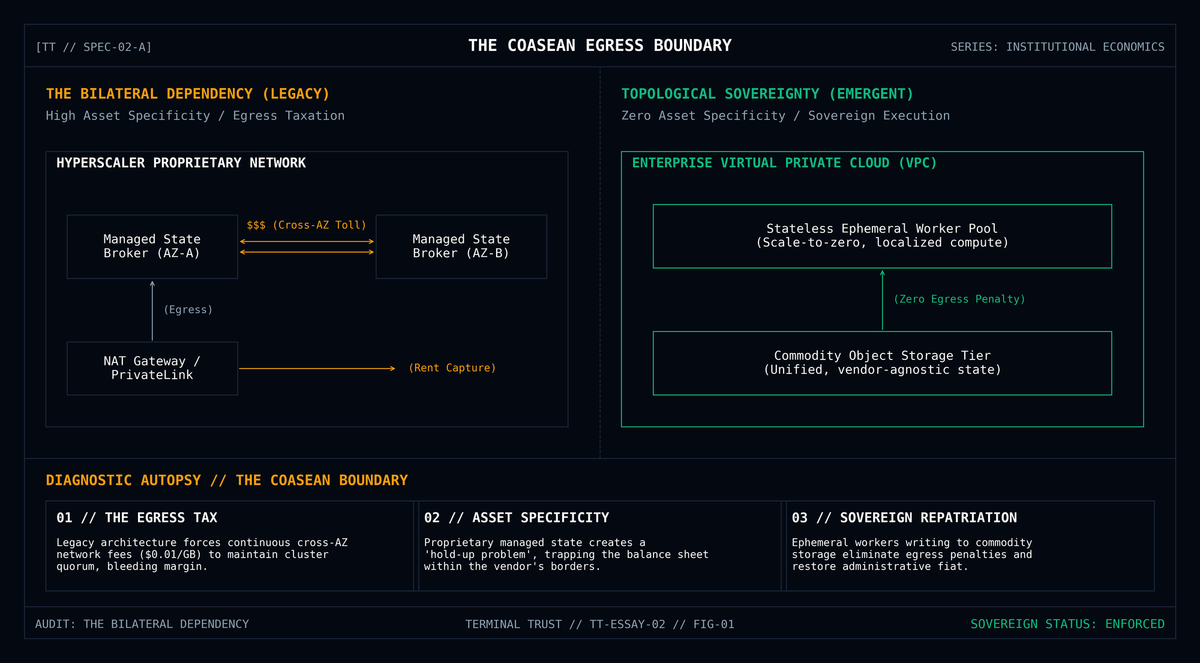
When state is coupled to local compute brokers, the enterprise bleeds margin through unbudgeted cross-AZ network taxes and the continuous cross-zone data movement required to maintain cluster quorum. The legacy architecture forces the enterprise to constantly transmit data across the vendor’s proprietary toll roads. Every byte that moves between a managed service in one availability zone and a database in another is intercepted, metered, and taxed by the hyperscaler.
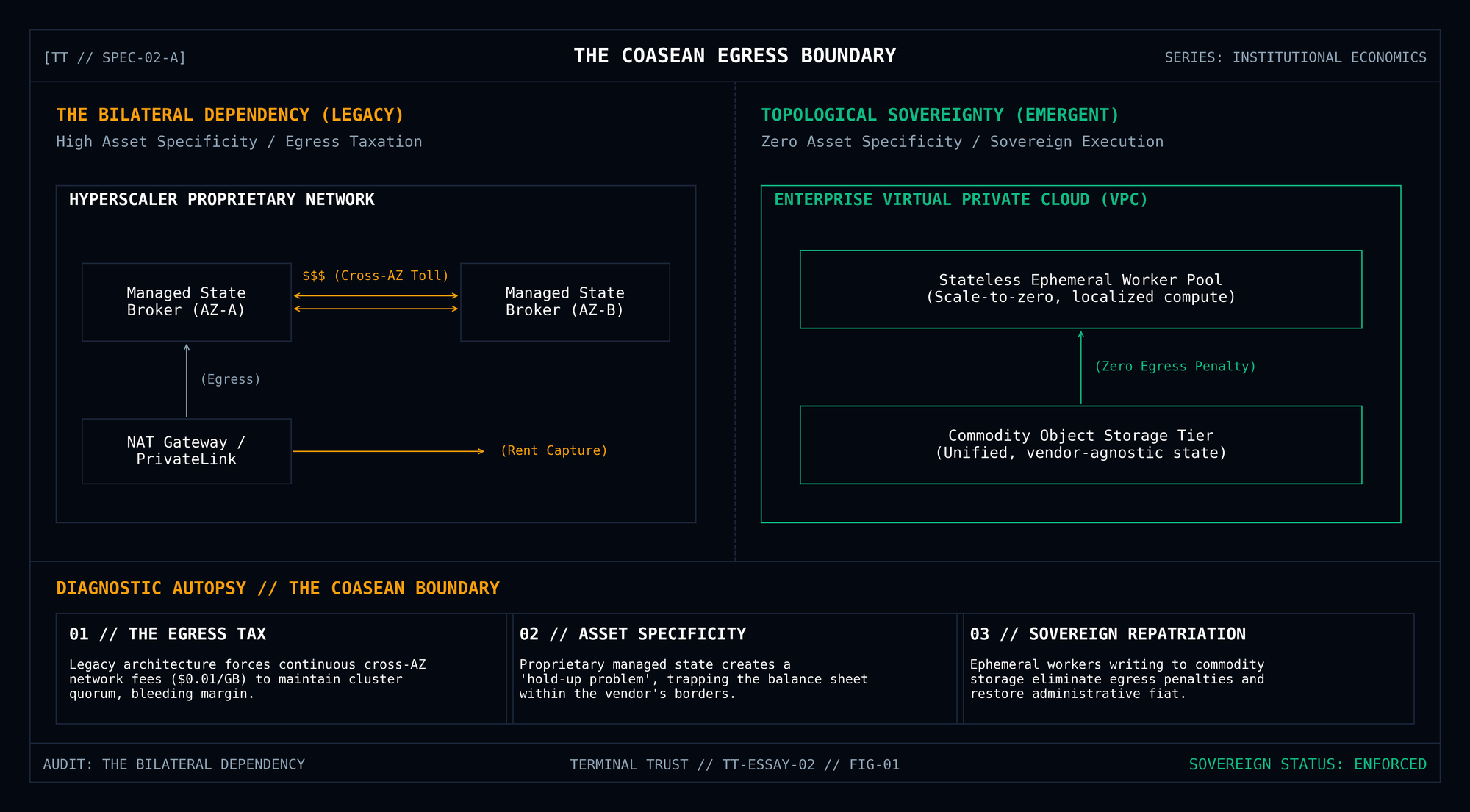
The contrast between these two paradigms is structural and irreversible. In the legacy state, data is held hostage across proprietary network borders, continuously incurring a $0.01 per GB cross-zone network fee just to ensure baseline durability. The hyperscaler is effectively monetizing the physical distance between its own servers, forcing the enterprise to pay for the privilege of keeping its data safe.
In the emergent Deployment paradigm, compute is decoupled and completely stateless. By exploiting Topological Sovereignty, ephemeral workers execute entirely inside the customer's VPC and write directly to a commodity object storage tier. Because the commodity object storage tier (such as S3) handles its own multi-AZ durability on the backend, the customer's compute plane never has to execute a cross-AZ network hop. This eradicates cross-chattering through expensive inter-AZ networking shims, completely insulating the enterprise customer's invoice from hyperscaler opportunism. The Coasean boundary is restored: the enterprise retains the administrative fiat of the data within its own VPC, externalizing only the lowest-level commodity storage to the market.
V. The Founder's Dilemma: Pitching Sovereignty
A distinct cohort of venture-backed infrastructure founders have successfully engineered the technical primitives required to break this bilateral dependency. Every modern stateless API, microservice, and decoupled platform they build fundamentally redraws the boundary of where the customer's engineering team ends and the external cloud begins.
Yet, when these founders face the enterprise procurement desk, they frequently fail. Despite possessing the exact architectural cure for the CFO's margin bleed, their sales cycles stall. This occurs because these founders carry massive Positioning Debt.
When an engineering founder pitches their decoupled architecture purely on the merits of raw speed—for example, claiming to be a "sub-millisecond columnar data store on S3"—they are pitching a technical feature to an economic buyer who is fighting a crisis of administrative control. The CFO does not care about microsecond latency advantages; the CFO is attempting to neutralize a multi-million-dollar structural cloud tax. Production capital does not reward feature-level optimizations with premium valuations.
By framing their architectural breakthrough around developer ergonomics or pure technical benchmarks, the founder incurs the Narrative Drift Tax—their sales cycle extends, and procurement rejects the contract because they cannot reconcile the pitch with their strict mandate for margin determinism. Procurement desks are trained to detect and reject new vendor lock-in. If a founder pitches an 18-month "rip-and-replace" migration simply to achieve faster queries, procurement will veto the deal, viewing it as the creation of a new, high-risk bilateral dependency.
Category sovereignty in the Deployment Period requires founders to weaponize Topological Sovereignty. Founders must stop selling feature roadmaps, latency benchmarks, or ZIRP-era developer velocity. They must articulate their product as the definitive institutional mechanism to eradicate asset specificity.
The pitch to the economic buyer must be clinical, structural, and uncompromising: The legacy vendor has trapped your balance sheet in a bilateral dependency. You are bleeding margin because your infrastructure is highly asset-specific and exposed to unchecked opportunism. Our architecture completely severs that dependency, eliminates your unbudgeted egress tax, and permanently repatriates administrative fiat over your infrastructure.
VI. Epilogue: The Repatriation of Control
The era of the cloud functioning as an unmanaged, infinite expanse subsidized by zero-interest capital is definitively over. As the transaction costs of the open cloud market begin to violently exceed the friction of internal coordination, a structural repatriation cycle is triggered. Enterprises are reclaiming their operational boundaries, demanding that their infrastructure serve their balance sheet rather than the hyperscaler's quarterly earnings report.
This transition is not a retreat; it is an evolution in institutional maturity. The enduring institutions of this next decade will not be the legacy vendors that promise to manage the enterprise's complexity in exchange for proprietary lock-in. The category sovereigns of the Deployment Period will be the infrastructure platforms that systematically eliminate asset specificity, granting the enterprise the ability to seamlessly substitute underlying commodity resources without penalty.
True infrastructure authority now belongs exclusively to the architectures that grant the enterprise the administrative power to dictate its own Coasean boundaries. To survive the modern procurement desk, founders must recognize that they are no longer selling software—they are selling the defense of the enterprise perimeter.
*Sources cited in PDF